
Mosaic from a description: a floor from words and a plan
The Studio algorithm builds a mosaic floor project from a description or a room plan: it lays every tile, draws the border and the field, estimates the material and produces a project sheet. Here are all the elements a floor is made of and how to choose them.
Subscribe to the opening Elements
What you give and get · Deliverables · Two scenarios · Elements · Recommendations · Figures · What is ready
What you give — what you get
You give
The subject in words and the floor size — or a floor plan of the room. Optionally: the field pattern, the border, colours, material.
You get
A mosaic floor project where every tile and joint is visible, and a documentation set with a material estimate.
What you get
A documentation set of four files.
| File | What it is |
|---|---|
| Full image | the whole mosaic from above, every tile visible |
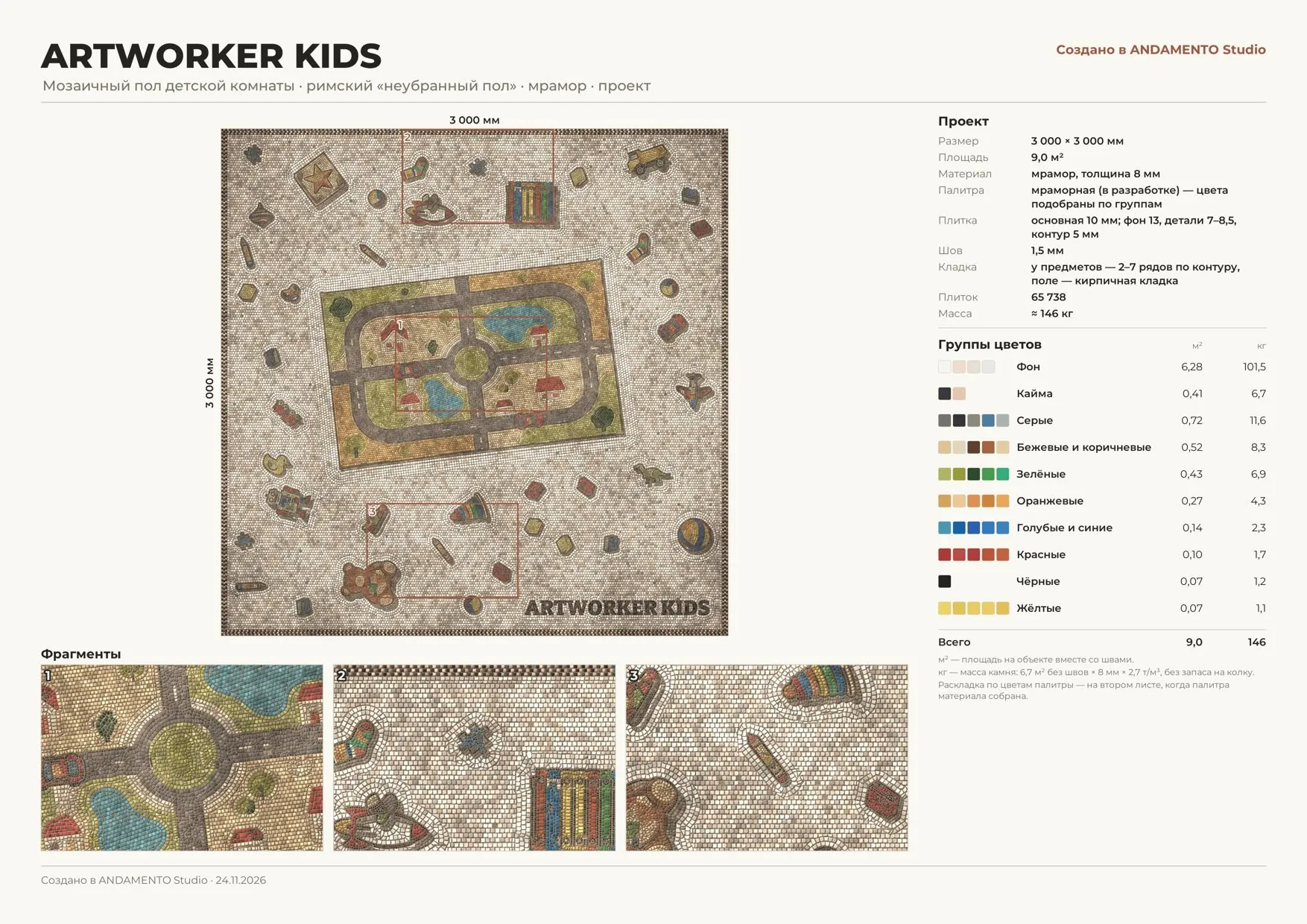
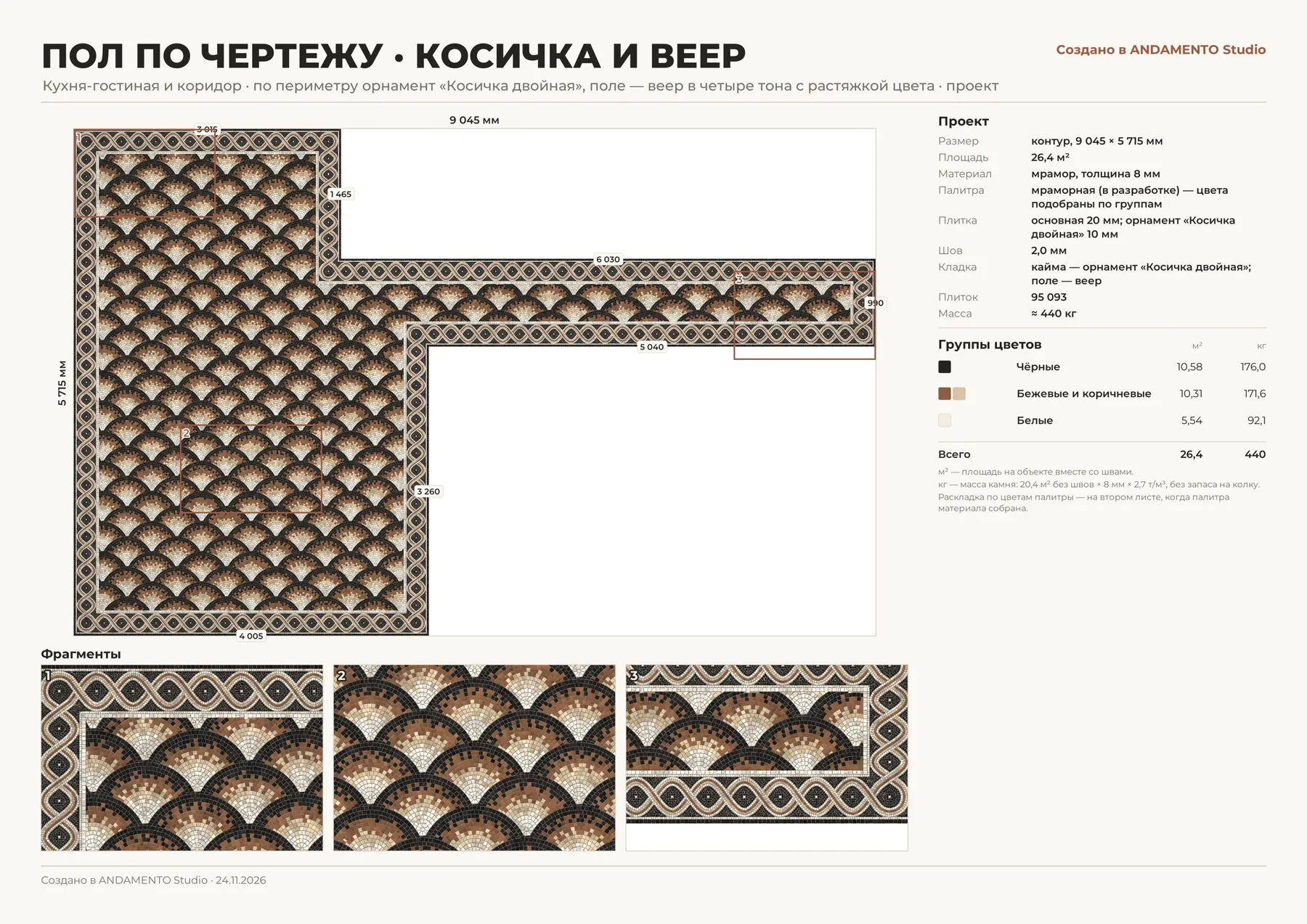
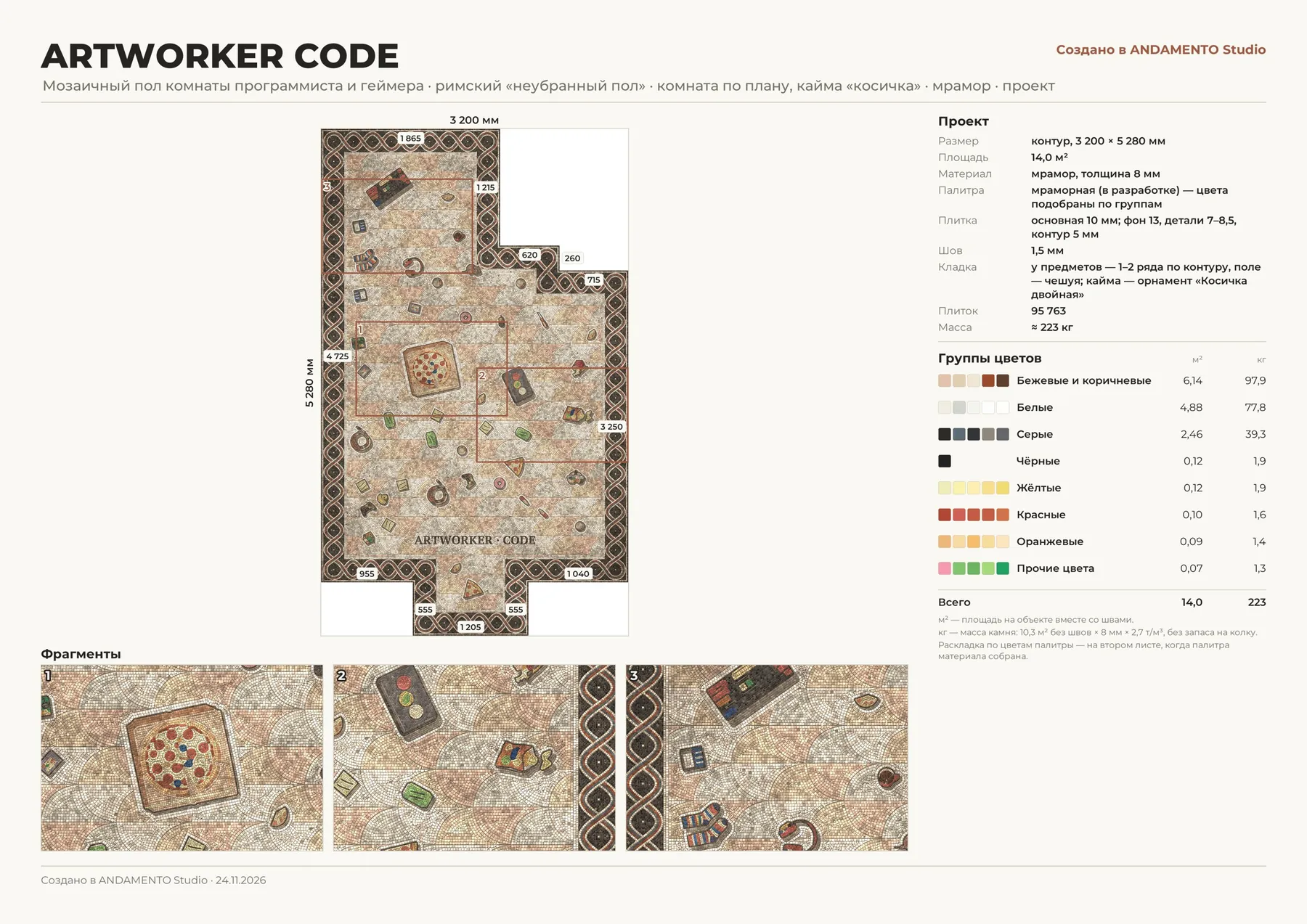
| Project sheet (A3, PNG and PDF) | a sketch with dimensions (for a floor from a plan — the length of every wall), three close-ups, area, material, tile, joint, laying, tile count, weight, colour groups in m² and kg |
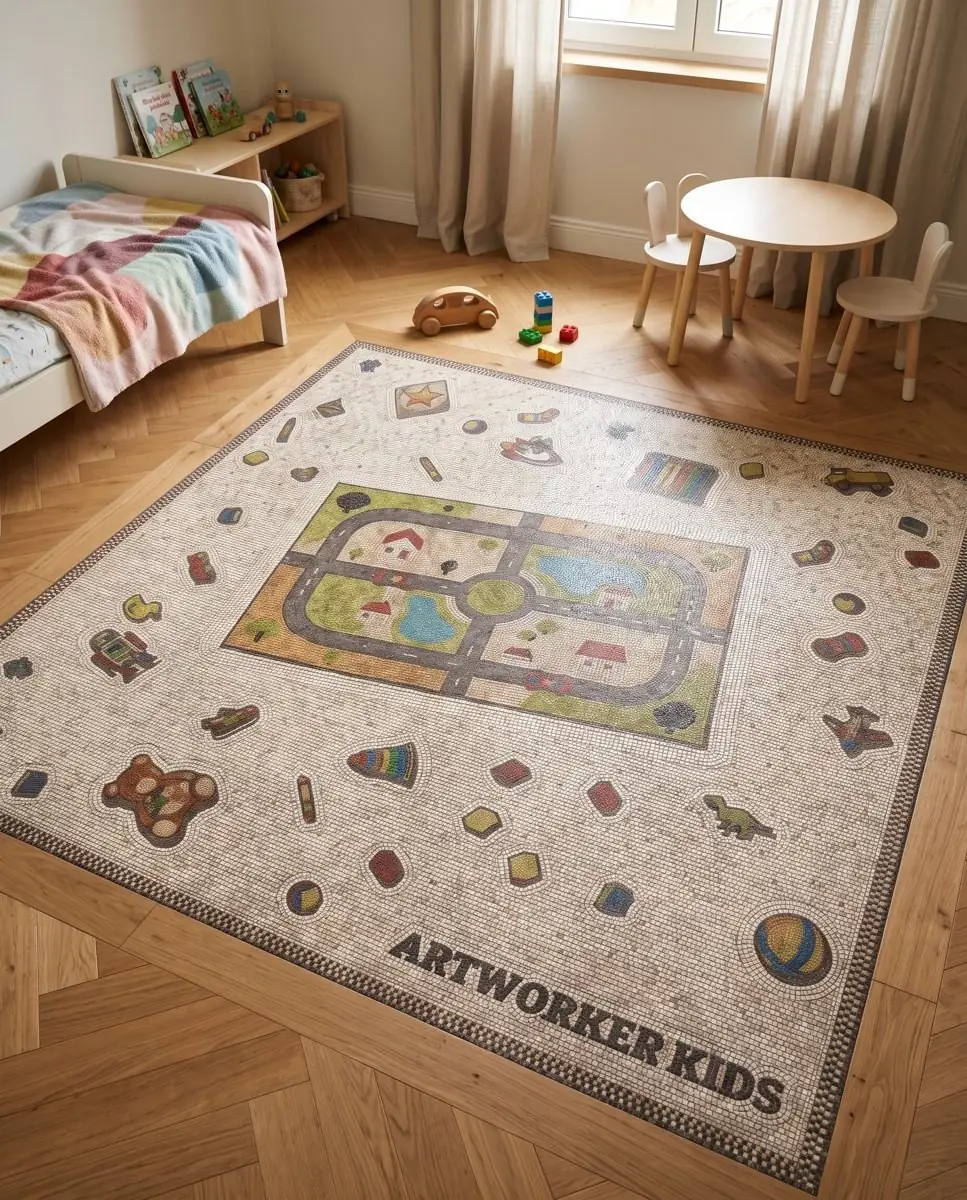
| Visualization | the floor in a room, a vertical frame; made as a separate step |
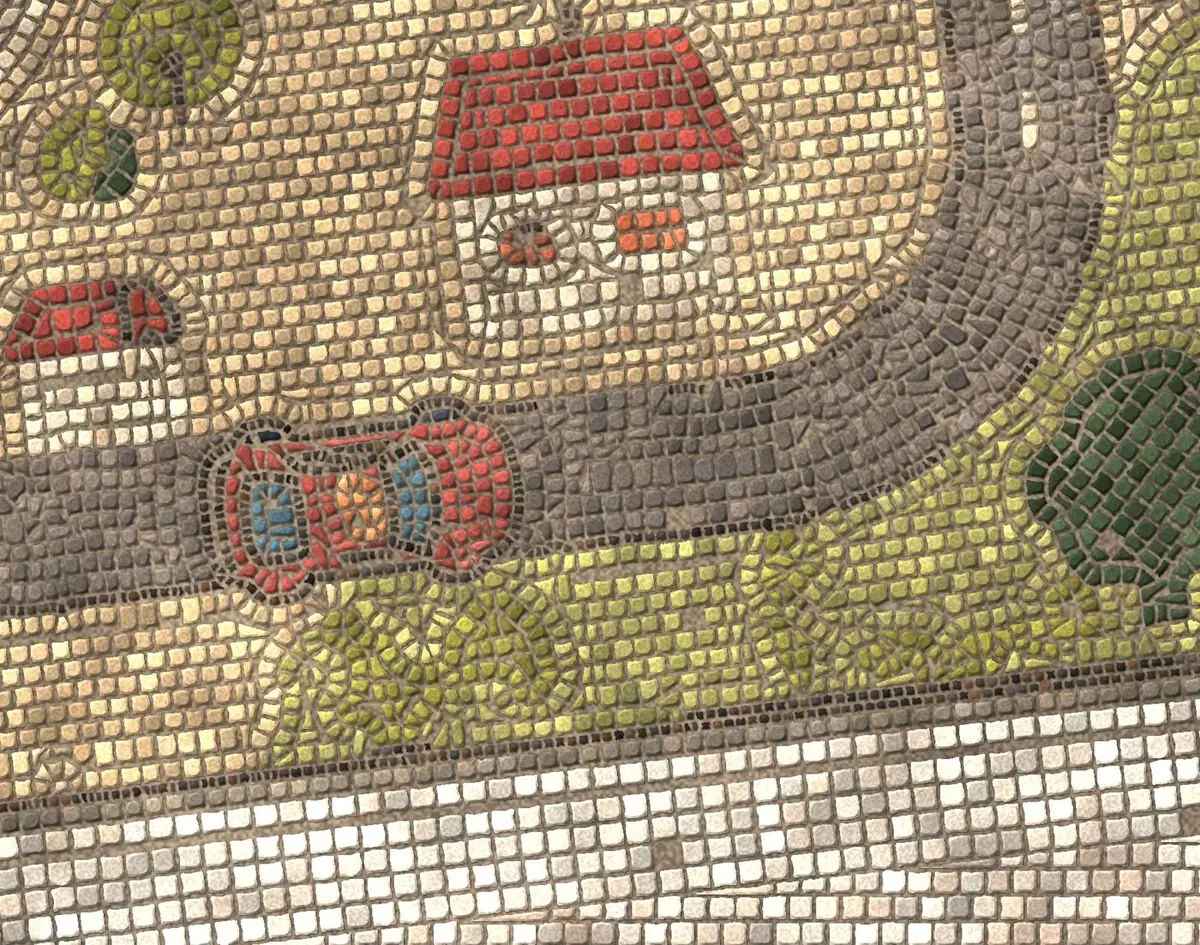
| Close-up | a 66 × 52 cm close-up: every tessera and joint is visible |
Two ready scenarios
The scenarios combine: an “unswept floor” can go into a room from a plan and get an ornamental border.
The “unswept floor”
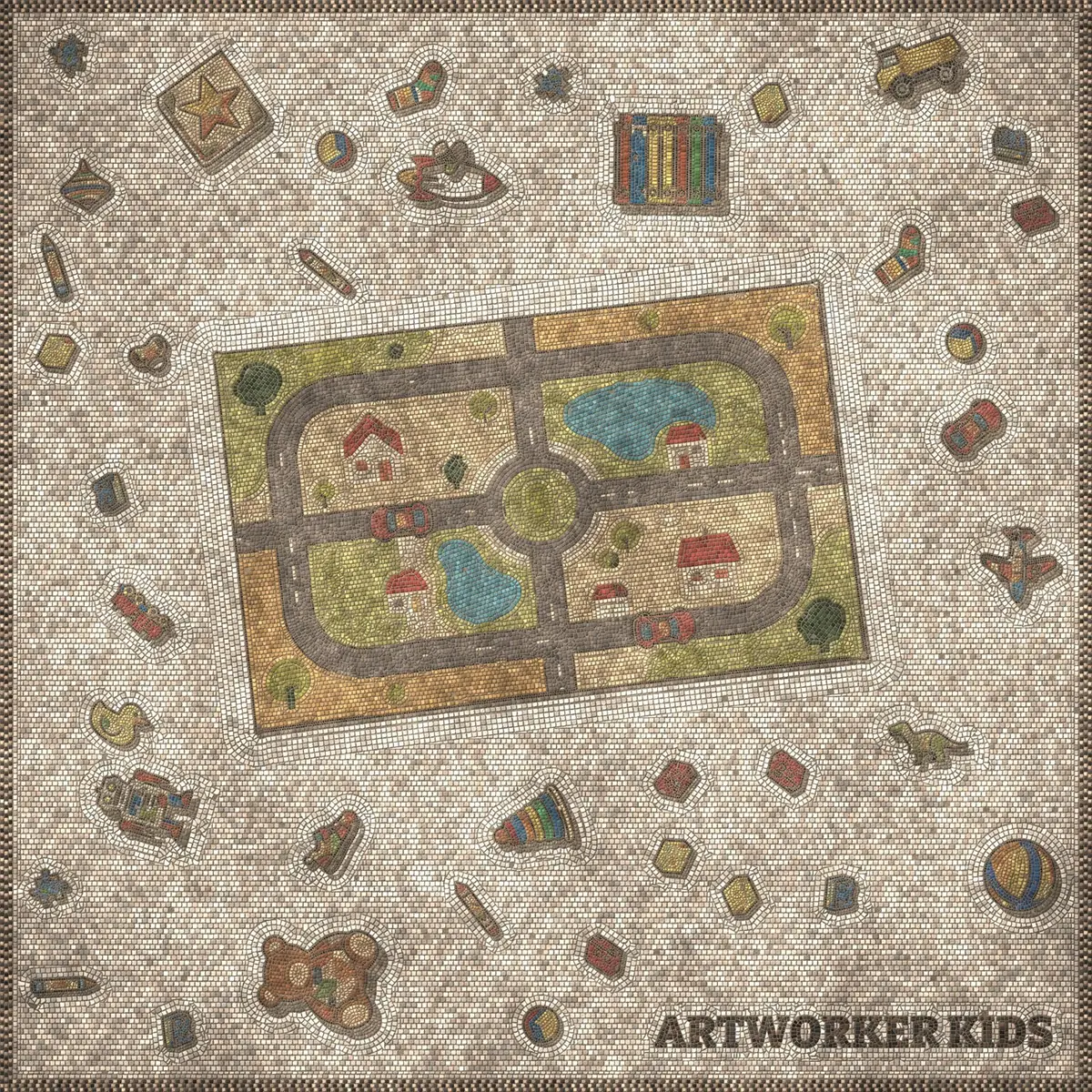
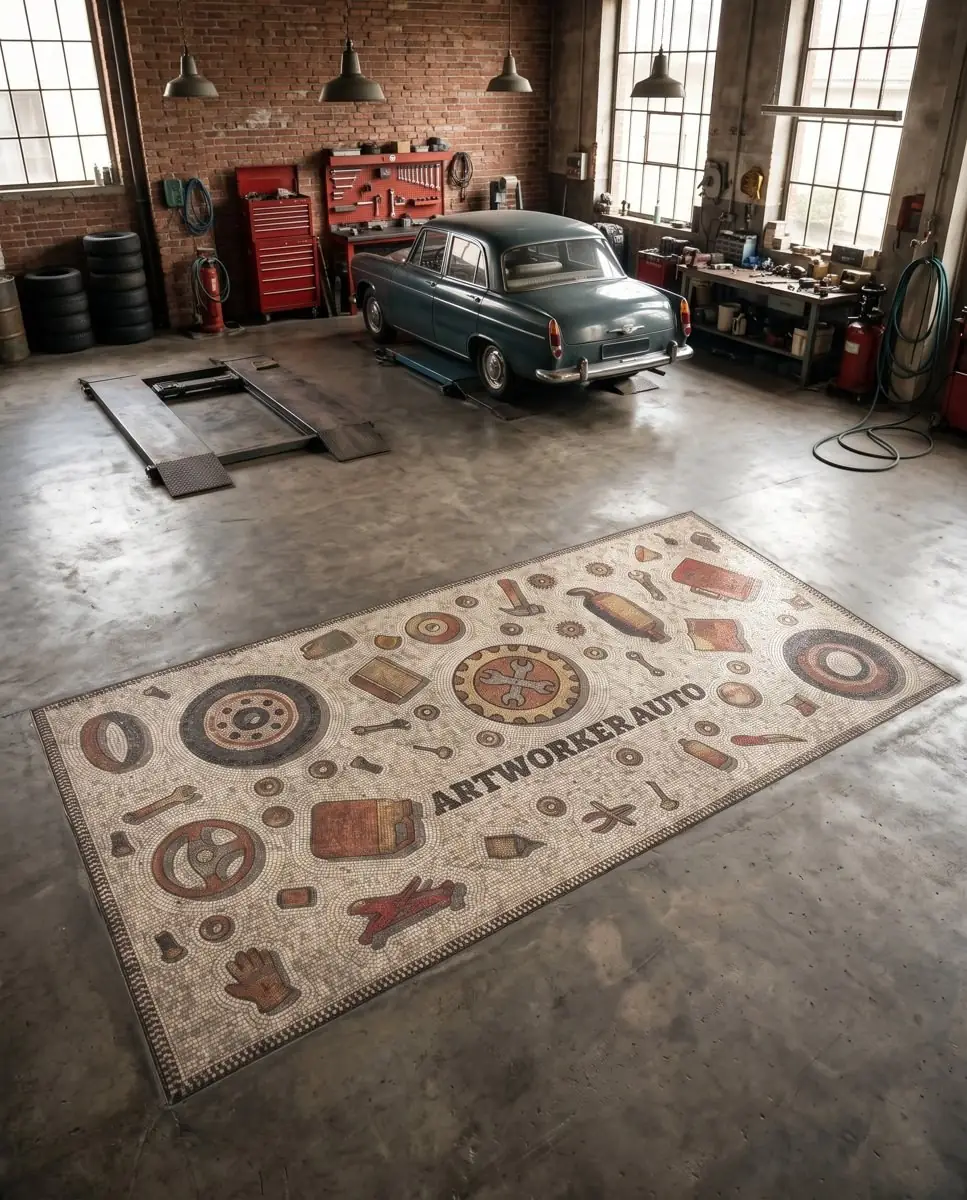
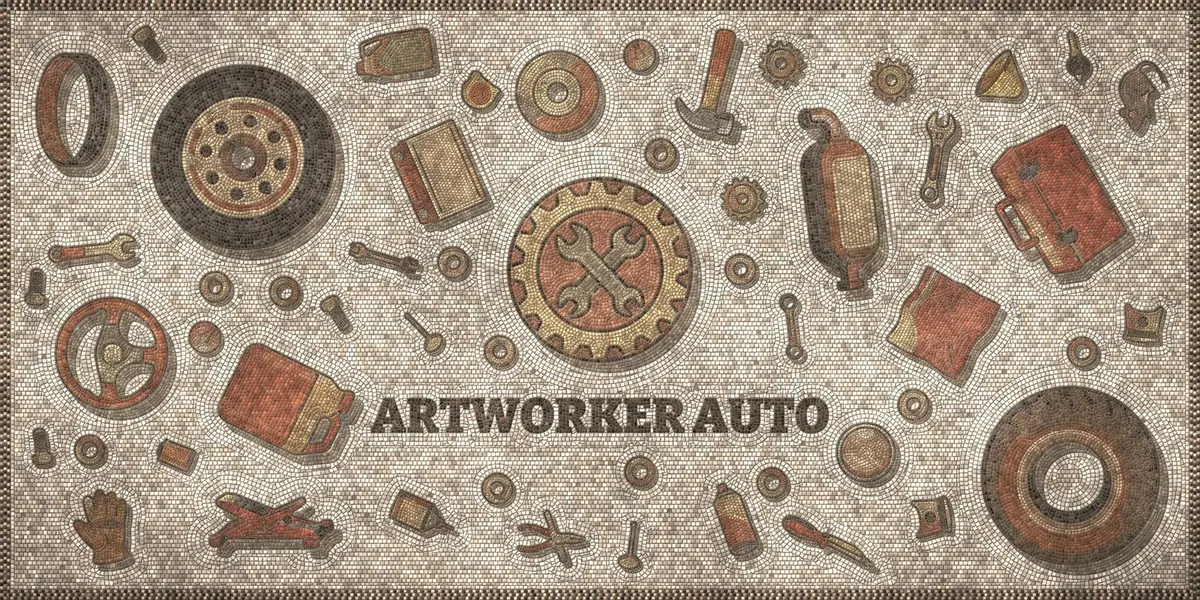
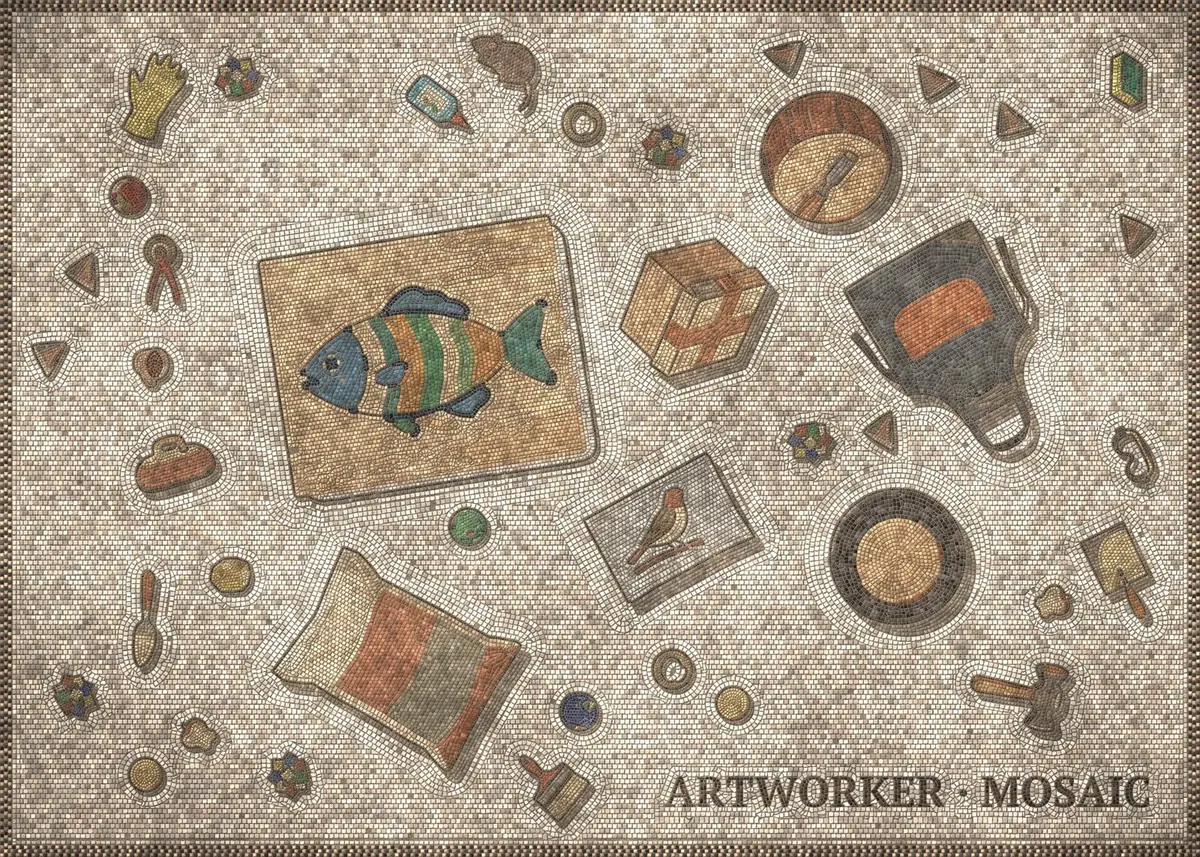
The ancient asarotos oikos: objects as if dropped on the floor, in the manner of an old Roman marble mosaic. The joint is visible, the tesserae are aged, dark areas are laid in several dark tones, objects cast shadows.
The “ARTWORKER floors” series: car workshop 4 × 2 m, children's room 3 × 3 m, mosaic workshop 3.5 × 2.5 m, a programmer's room from a plan 3.2 × 5.3 m, a round zoo floor ⌀ 3.6 m.
“Floor from a plan”
The client sends a floor plan — the project is made to its dimensions, in any shape: wall outline, a border along the perimeter, a patterned field.
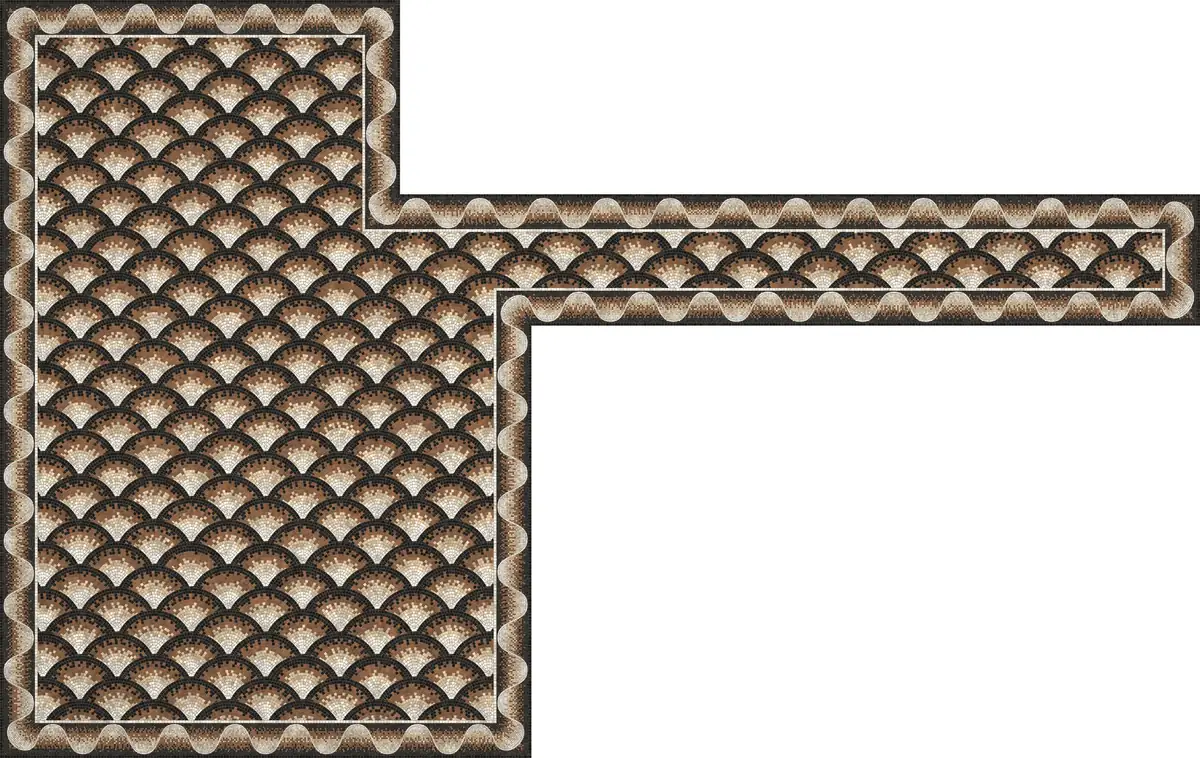
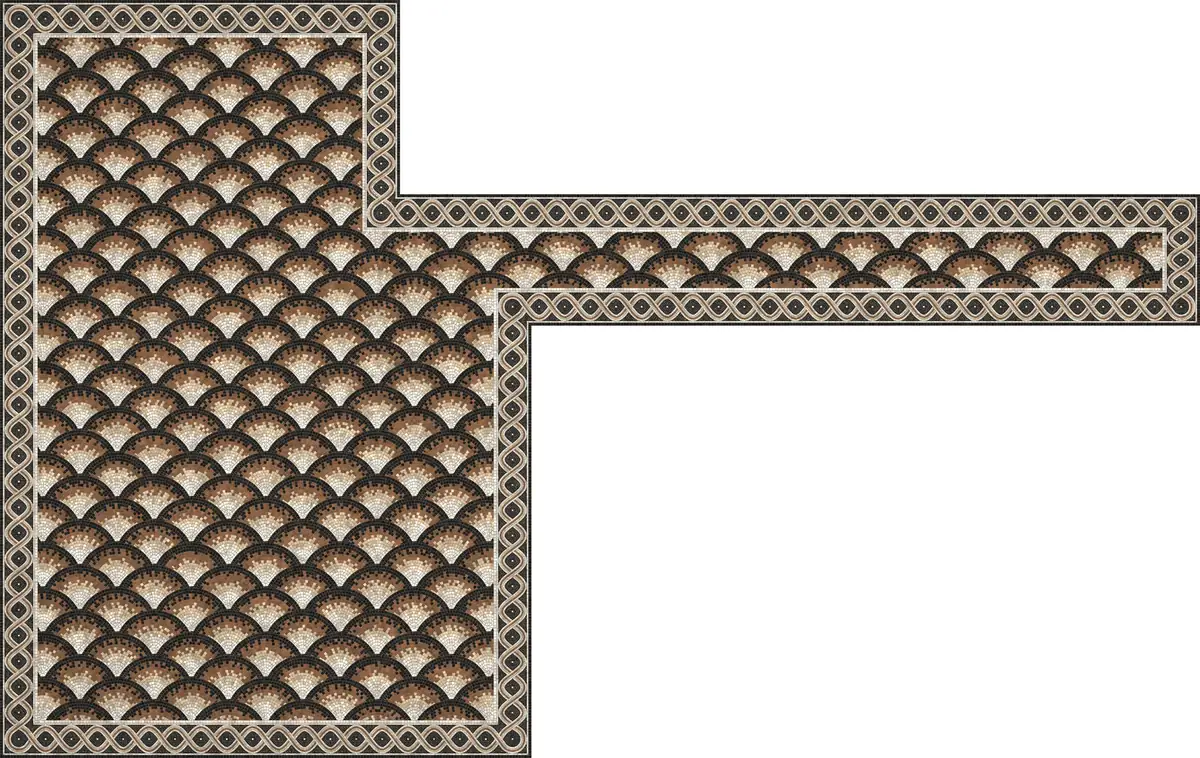
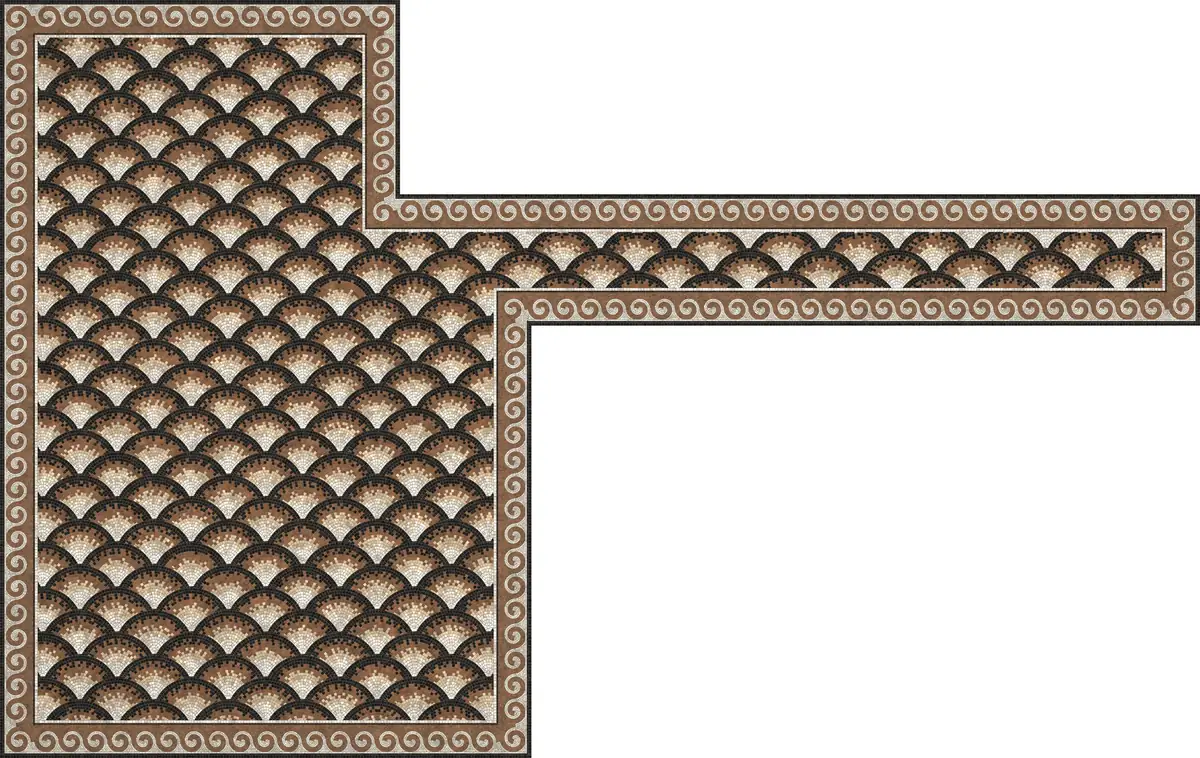
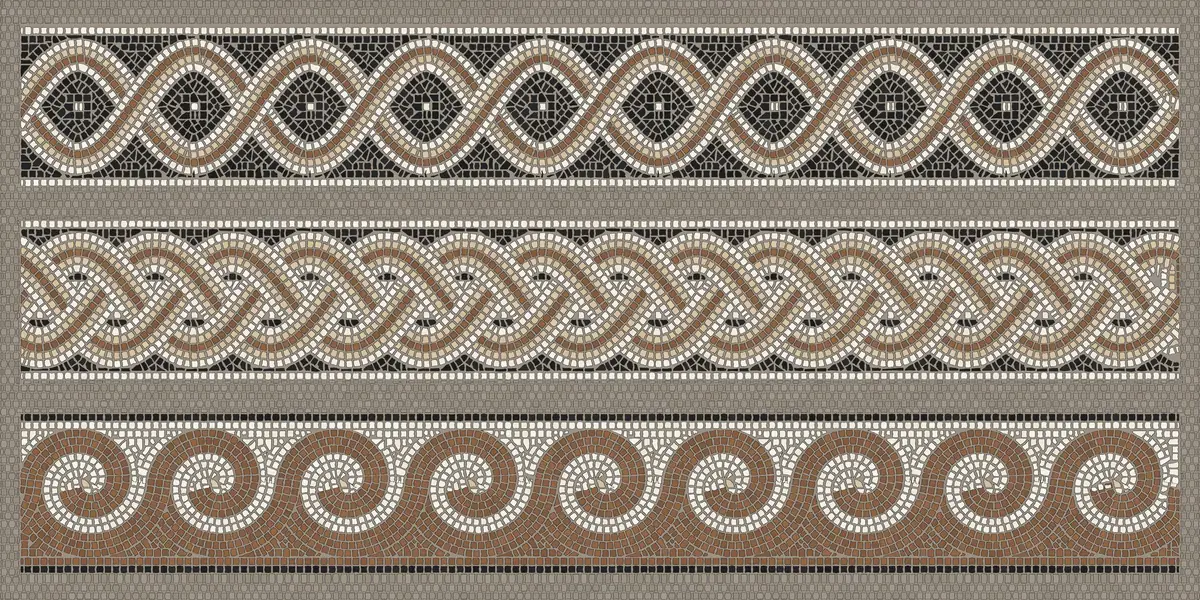
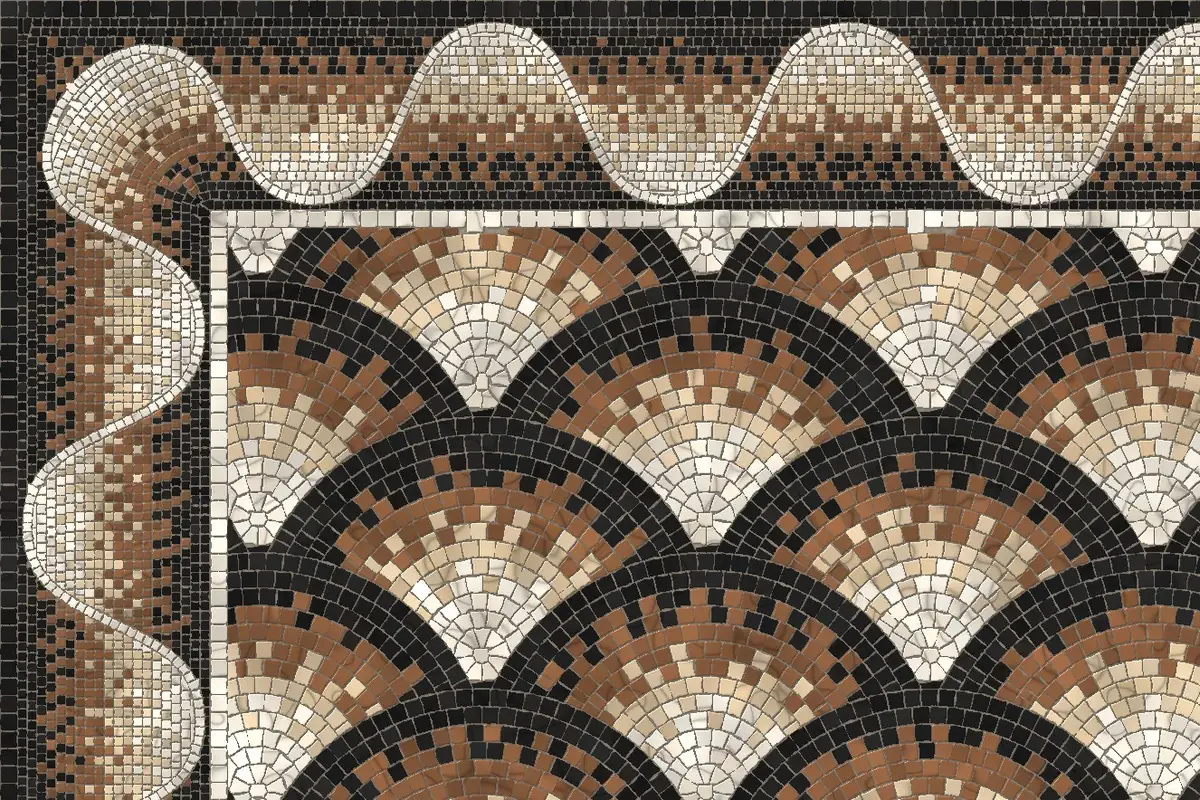
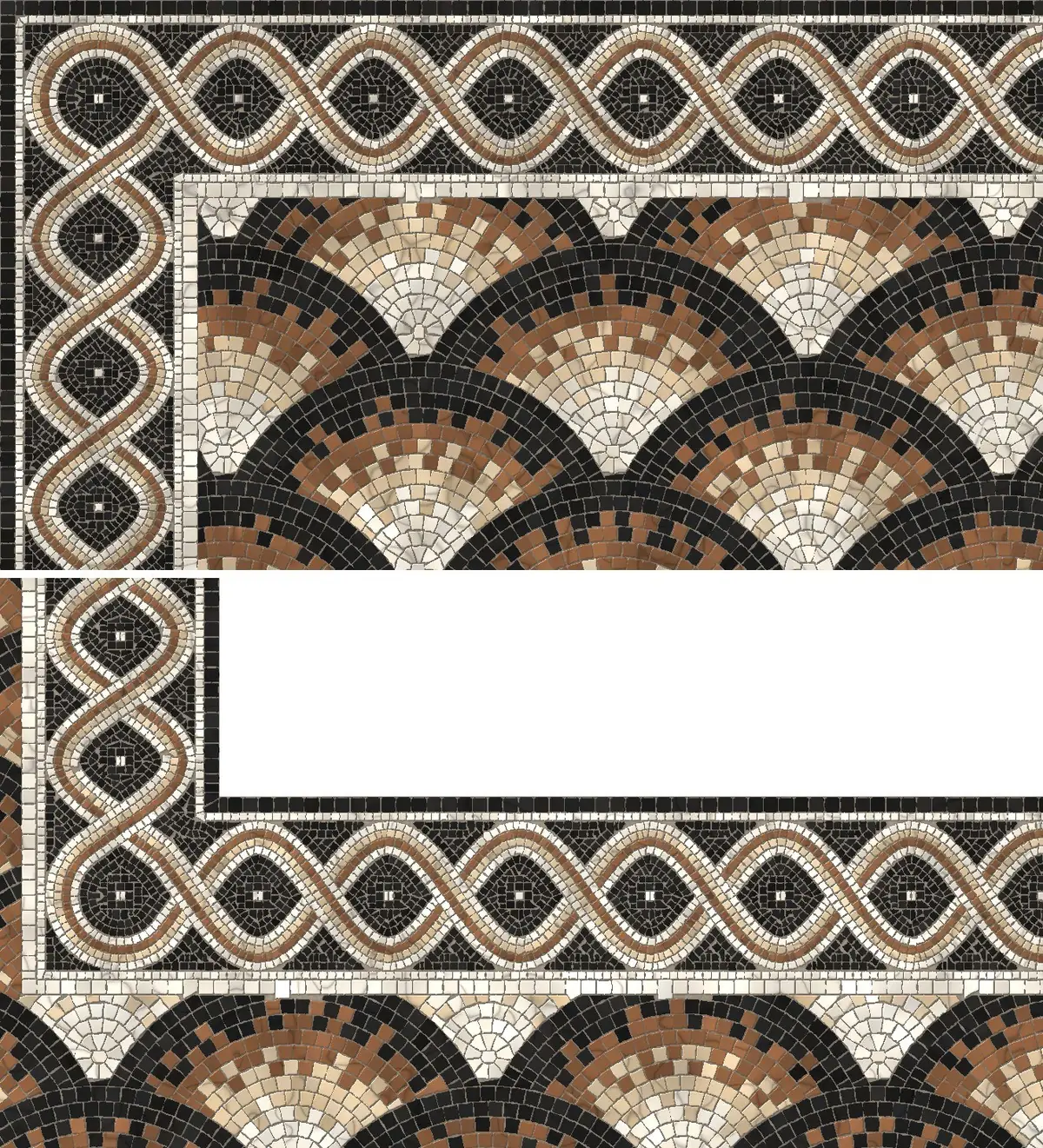
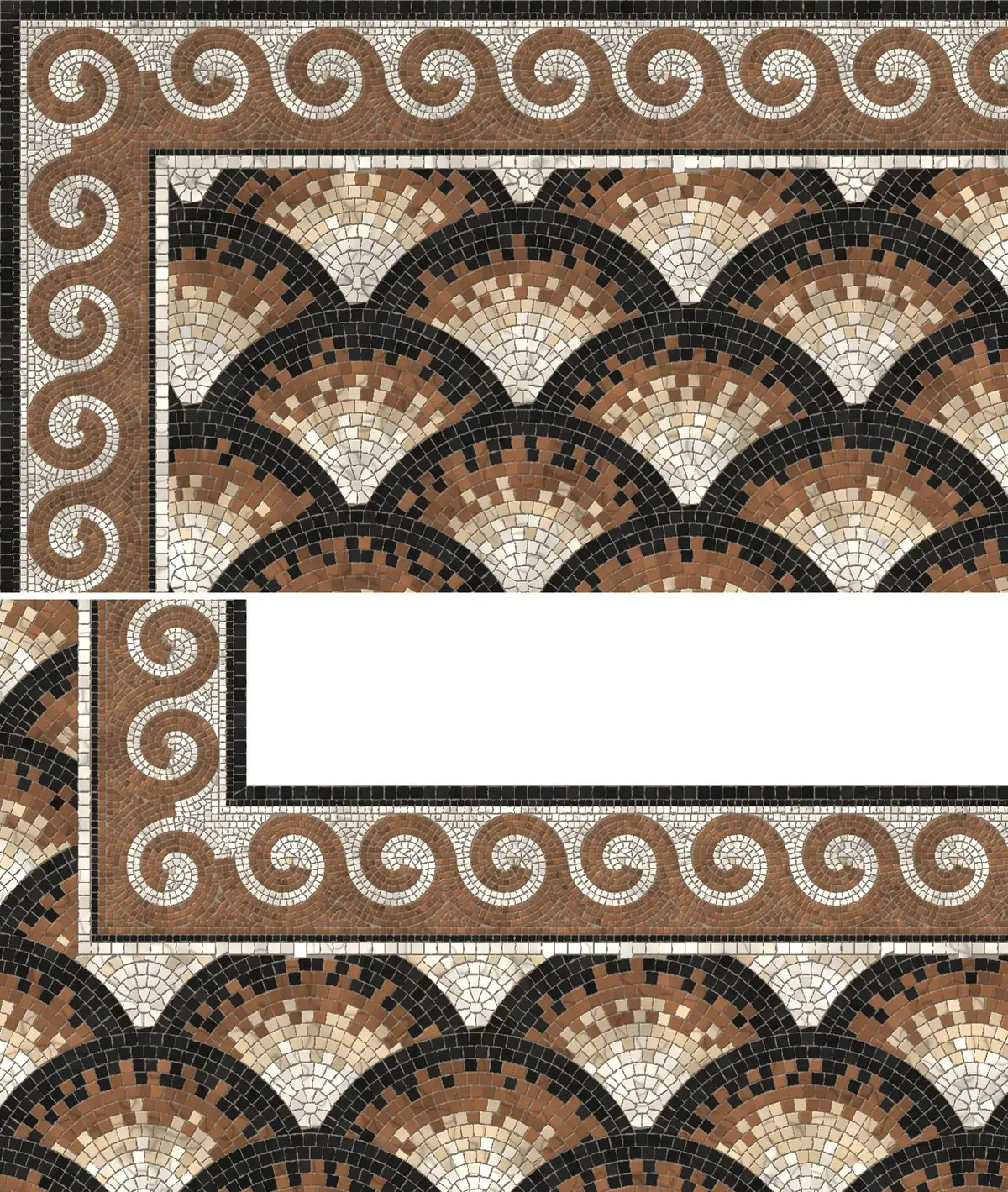
Example: a 26.4 m² flat floor (kitchen-living room and hall, 8 walls) with three border options — Wave, Double braid, Running wave; the field is a fan.
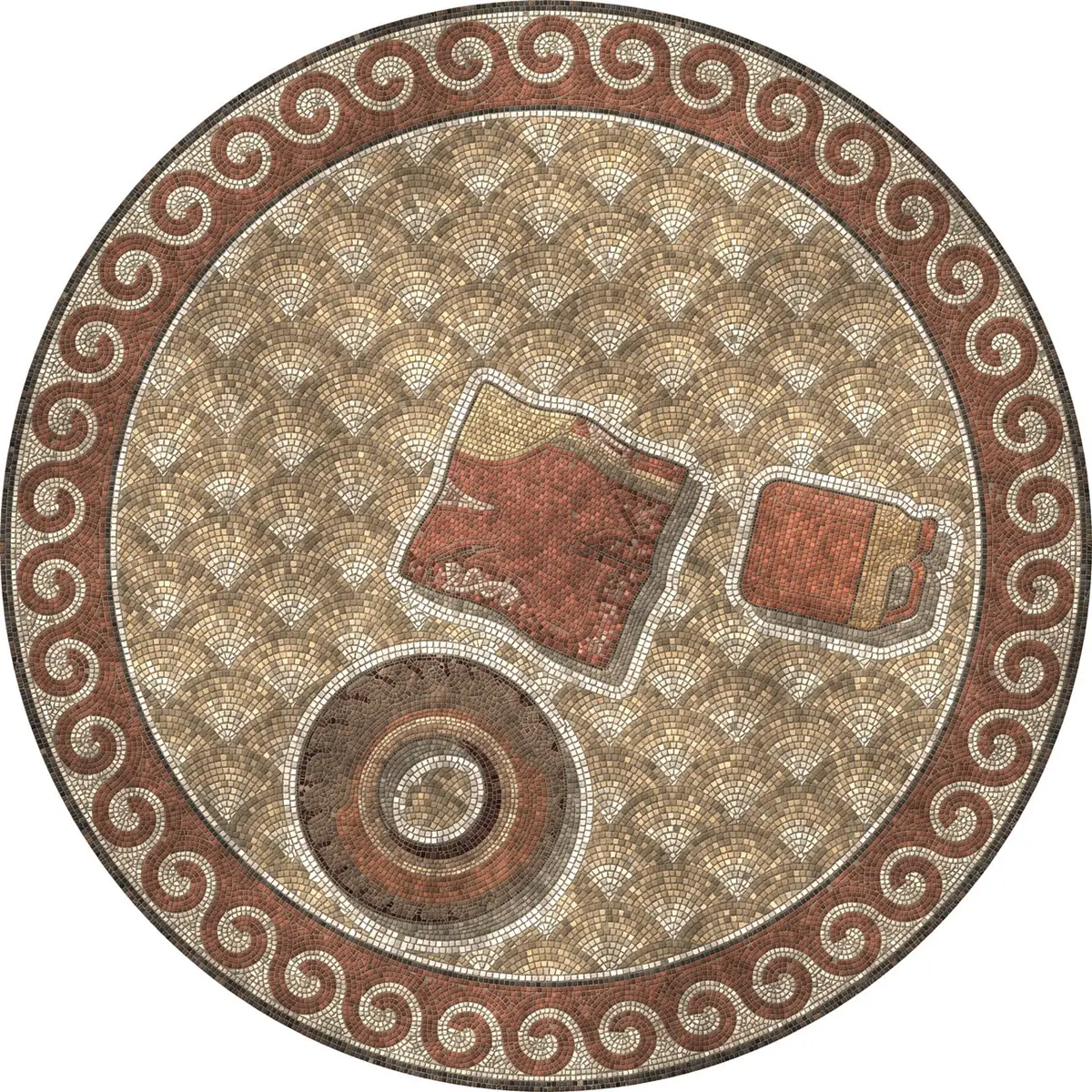
What a floor is made of
All the elements to choose from: shape, field, border, colour blend, objects, material and stone look.
1. Floor shape
Rectangle · circle · oval · octagon · outline from a plan (any polygon — the walls of the room). Sides up to 12 m. No tiles outside the floor.
Plan → outline. From the room plan we get an outline in millimetres with the length of every wall. The scale comes from a labelled area, a dimension line or a known size; the outline is checked against a check image.
2. Field — how to fill the middle
| Pattern | What it looks like | When to use it |
|---|---|---|
| from the figure | rows flow around the objects all the way to the border (Roman opus vermiculatum) | a logo, a coat of arms, one main figure |
| rows | even brick bond | a calm background for many objects (the “unswept floor”) |
| matrix | an even grid | a strict, modern look |
| circles | rings from the centre | a round floor, a medallion |
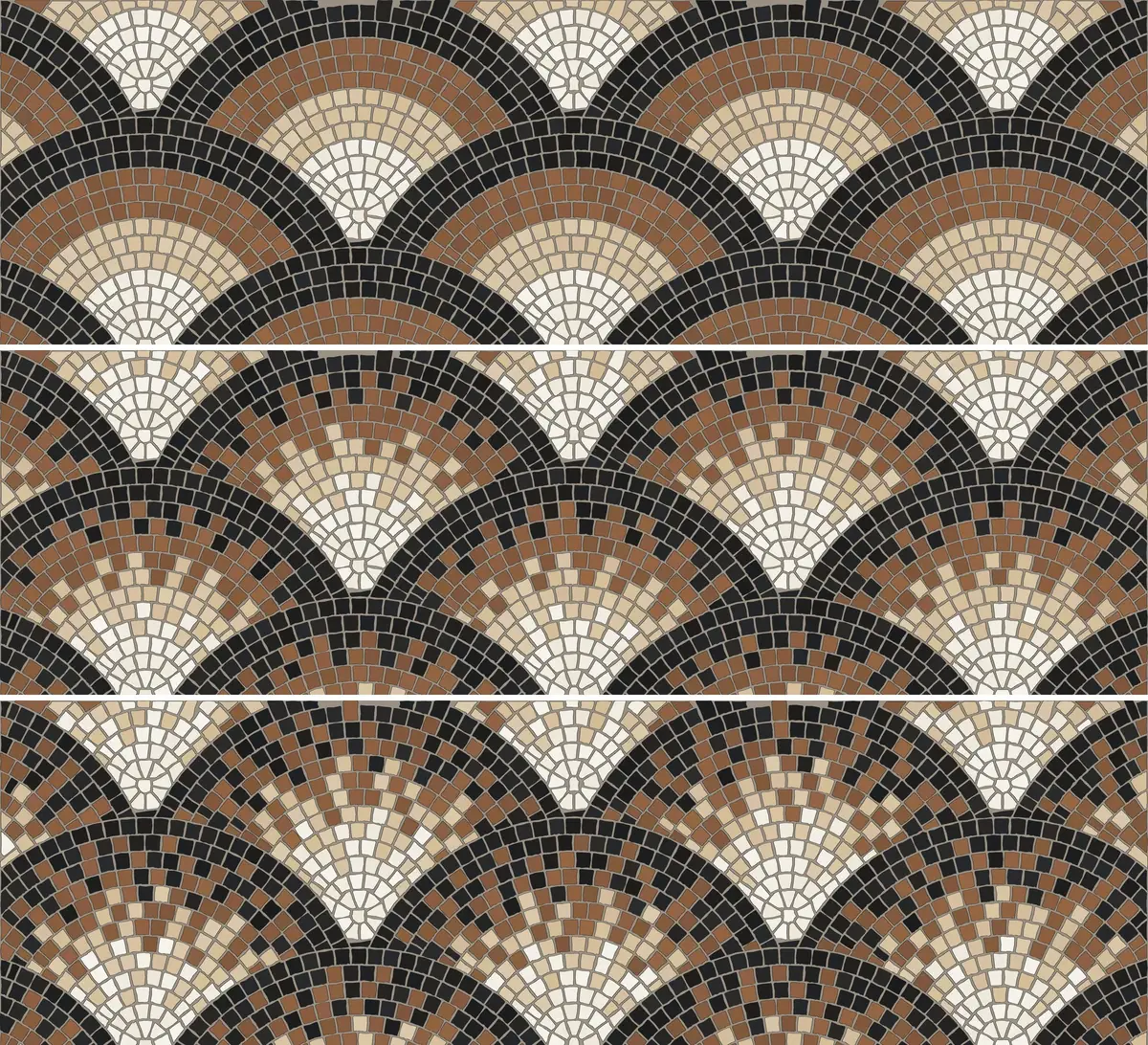
| fan | rows in arcs, “fans” in a staggered order — a classic of formal floors | a formal field with no subject or with few objects |
| scales | a field of “scales”, each its own colour | water, fish, oriental motifs |
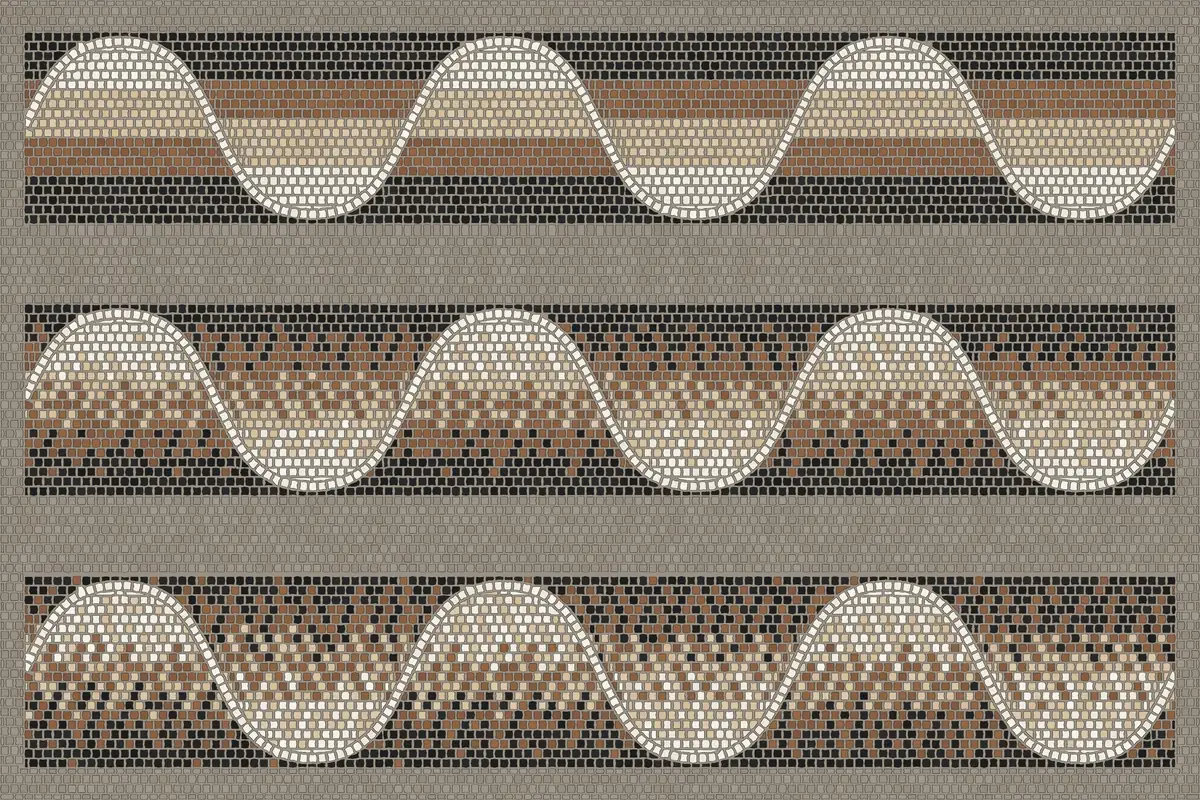
| wave | bands with a wave line and a tone transition | a rhythmic field, a frieze |
| running wave, double braid, triple braid | the same ornaments as the border, in rows across the whole field | a carpet pattern |
Fan, scales, circles and wave fields are laid in four colours.
3. Border along the perimeter
A simple one — one or two dark rows along the walls. Or an ornament — a band along the whole outline that turns corners without a break.
| Ornament | What it looks like | At the corner |
|---|---|---|
| Wave | a wave line one tessera wide; on both sides the rows change tone — dark at the edge of the band, light towards the crest | the crest bends into the corner like a petal |
| Running wave | the two-colour wave of Roman borders: the body rises from the base, the crest curls inwards | a whole scroll in every corner, a new one starts after it |
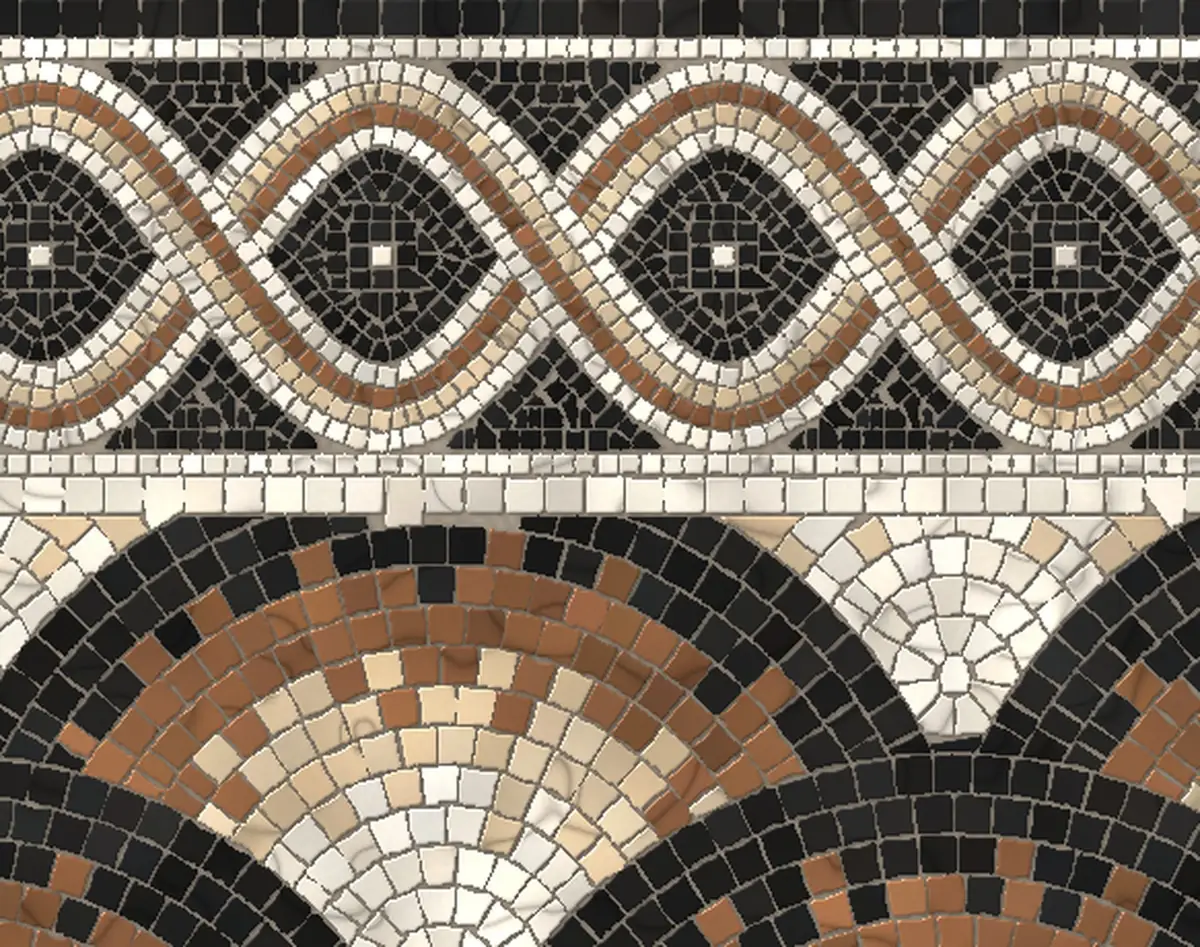
| Double braid | two interlaced strands with an eye in every loop | a round loop with an eye at the centre of the corner |
| Triple braid | three interlaced strands | follows a rounded line (no whole motif in the corner yet) |
A whole number of waves, loops or scrolls always fits between corners: the motif length stretches or shrinks slightly (invisible on a wall longer than a metre). On a short wall (a 25–40 cm cupboard step) the motifs of its two corners sit side by side.
4. Colour blend
Neighbouring colours of a wave or fan do not stop at a row; they mix at the boundary: rows near the boundary carry some tiles of the neighbouring colour, more the closer they are.
| Step | Transition |
|---|---|
| Sharp | the colour changes exactly by rows |
| 1 row | one row on each side of the boundary is mixed |
| Third | a third of the colour band is mixed with the previous colour, a third is pure, a third is mixed with the next (the usual blend) |
| Half | only the middle row of the colour stays pure |
| Smooth | the smoothest transition: the first and third colours meet inside the second |
5. Objects (the “unswept floor”)
- Objects follow the description, with sizes true to life: a jerrycan is bigger than a spanner.
- Crisp outlines and shadows, holes included.
- Objects are scattered without heaps or bare patches; they can also be placed by hand; lettering is a separate layer.
6. Material and estimate
The material follows the brief rather than “always smalto”: for an ancient floor it is 8 mm marble. Until a material palette is ready, the project sheet lists colours in groups (beige and brown, white, grey, black…) with area in m² and weight in kg.
7. Stone look
Render styles: “antique”, “old antique” (uneven tesserae, chipped corners, missing tiles, stains, cracks — for the “unswept floor”), “polished stone” and others.
Recommendations
Rules for choosing the elements.
| Topic | Rule |
|---|---|
| Ornament height | a wave, braid or running wave reads from twenty rows of tiles: from 20 cm with 10 mm tiles, from 40 cm with 20 mm tiles |
| Border tile | the border gets small tiles even when the field is large: field 20 mm, border 10 mm |
| Narrow spots | the narrowest part of the floor should be wider than two ornament heights |
| Projections and niches | a wall shorter than two ornament heights gives a squeezed motif; projections work best from 50 cm |
| Objects on a patterned field | if the field is a fan, scales or another figured pattern, keep one or two outline rows around an object, no more: four or five look like a heavy outline and knock the object out of the background |
| Objects on a plain field | 2–7 rows along the outline, then even laying: more for the main object, fewer for small ones |
| Field colours under objects | light ones: a dark fourth fan tone “drowns” the objects |
| Colour blend | shows when the tones differ in lightness (light — two middle — dark); the usual step is “Third” |
| Black | “black is not black”: dark areas are laid in several dark tones (charcoal, dark grey, brown) |
| Joint | an old Roman floor has a visible joint: 1.5 mm |
| Floor plan | take the scale from a labelled area or a dimension line, not by eye; check the outline against the check image |
Figures
Finished floors of the series.
| Floor | Area | Tiles | Weight (8 mm marble) |
|---|---|---|---|
| car workshop 4 × 2 m, 54 objects | 8.0 m² | 61,510 | ≈ 128 kg |
| children's room 3 × 3 m, 43 objects | 9.0 m² | 65,738 | ≈ 146 kg |
| mosaic workshop 3.5 × 2.5 m, 41 objects | 8.75 m² | 59,538 | ≈ 143 kg |
| room from a plan 3.2 × 5.3 m: braid, scales, 45 objects | 14.0 m² | 95,837 | ≈ 223 kg |
| circle ⌀ 3.6 m: wave, fan, 42 objects | 10.2 m² | 74,843 | ≈ 165 kg |
| flat from a floor plan: ornament border in 10 mm tiles, fan field in 20 mm | 26.4 m² | 94–96 thousand | ≈ 440 kg |
What is ready
Already in the Studio interface
The interface is in Russian. The «Чем мостить фон» (background fill) window has the Wave, Running wave, Double braid and Triple braid patterns with Height, Length and Rotation fields; the «Растяжка цвета» (colour blend) setting has five steps from Sharp to Smooth; each layer has «Кладка внутри» (laying inside) with the same ornaments.
For now, our team builds description-to-mosaic projects; this step will come to Studio later.
Not yet
- The triple braid has no whole motif in the corner yet.
- Colour blend works for the wave and the fan, not for the other patterns.
- Material palettes (marble) are not assembled yet — the estimate is by colour groups.
- Room visualization is made only on a separate request. Drawing from a photo is not supported.
ANDAMENTO Studio opens soon
Leave your email and we will write once, on opening day.